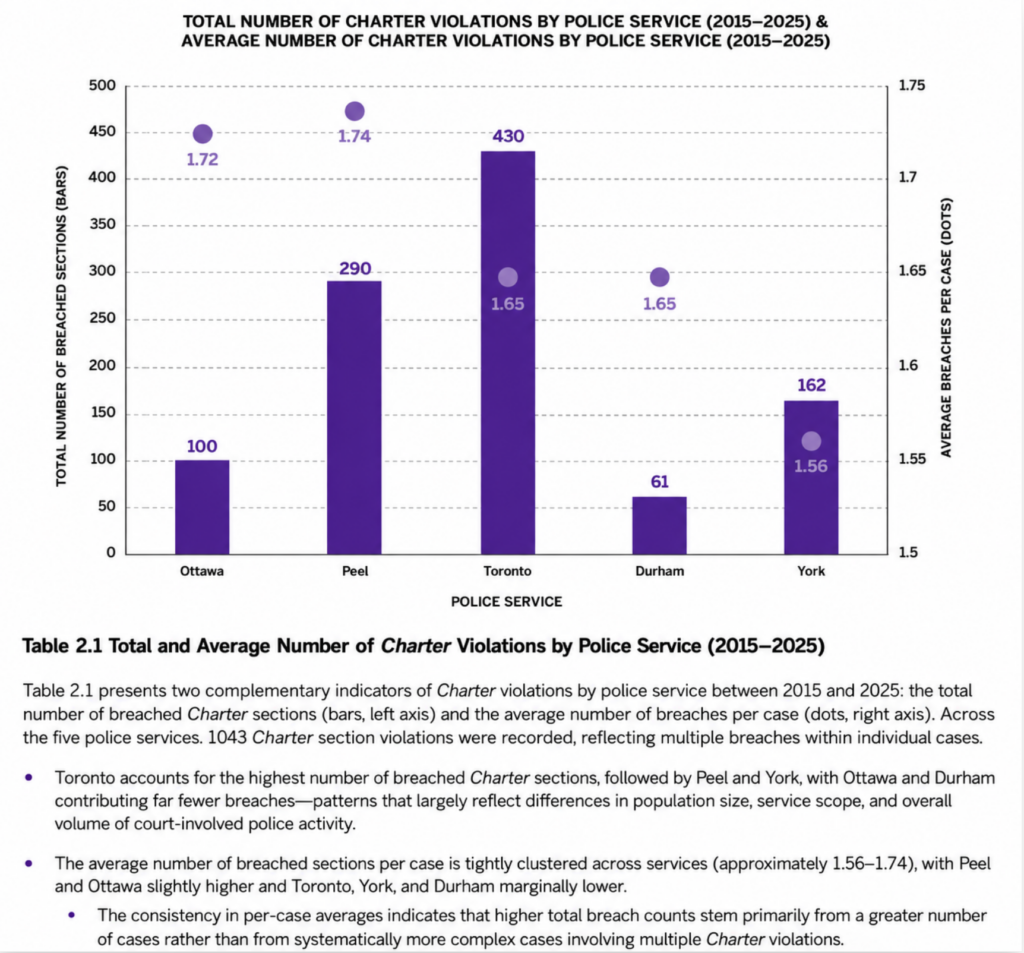
The Canadian Charter of Rights and Freedoms forms part of the Canadian Constitution and protects individuals against unjustified state interference. A recent report published by researchers from the University of Toronto and Western University has highlighted serious concerns regarding unconstitutional police conduct in Ontario. The report, Unlawful Enforcers: Charter Violations by Major Ontario City Police Services (the “Report”), was released on March 18, 2026. The findings are directly relevant to anyone facing criminal charges in Ontario and across Canada, including Alberta. It analyzed court decisions from 2015 to 2025 involving Ontario’s five largest municipal police services and examined the rate at which police breached the Charter rights of accused persons during criminal investigations. According to the Report, courts found over 1,000 Charter violations in more than 600 reported criminal cases involving the Toronto Police Service, Peel Regional Police, York Regional Police, Durham Regional Police Service, and Ottawa Police Service. The Report also found that, where at least one Charter breach was established, the average number of violations per case ranged from approximately 1.56 to 1.74 breaches. In practical terms, this means that when a court found one Charter violation, there was often more than one unlawful act committed against the accused by state agents during the investigation.
Of the approximately 600 cases analyzed, over 70% were classified as “serious” Charter breaches. These were cases where courts excluded evidence, entered a stay of proceedings, or granted sentence reductions as a remedy for unconstitutional police conduct. The Report’s analysis of the data supported the conclusion that the increase in Charter violations was driven primarily by more cases involving breaches, rather than by more legally complex cases involving multiple issues. The graph below is a helpful visual representation on this point:
At page 3 of the Report, the writers state that of the reported Charter violations, breaches of sections 8 and 10(b) were disproportionately high. Those rights are:
Section 8: Everyone has the right to be secure against unreasonable search or seizure.
Section 10(b): Everyone has the right on arrest or detention to retain and instruct counsel without delay and to be informed of that right.
Together, these two Charter protections accounted for more than 65% of all violations identified in the study.
Sections 8 and 10(b) sit at the core of constitutional protections against unlawful state intrusion and coercive police conduct. Section 8 protects individuals from unreasonable searches of items that are deeply personal, where members of the public can expect to have a “reasonable expectation of privacy.” Examples include homes, vehicles, cell phones, purses, and backpacks. Section 10(b) protects individuals from being subjected to investigative steps, including attempts to obtain statements or confessions, before they have had a meaningful opportunity to speak with legal counsel.
The right to speak with counsel and obtain legal advice before participating in any investigative steps with the police is especially important. The Supreme Court of Canada held in R v Sinclair, 2010 SCC 35, that section 10(b) does not provide Canadians with the right to have a lawyer physically present during a police interrogation, unlike in the United States (paras 33-42). Therefore, section 10(b) exists to help level the playing field when an individual is confronted by the immense power of the police and the state. A lesser-known component of section 10(b) is that it includes the right to contact counsel of choice, which the Report found was a systemic issue (among 20 others) perpetrated by the Toronto Police Service and Peel Regional Police during investigations:
“Systemic issues contribute to the problem. Our qualitative analysis of court decisions involving the Toronto Police Service and Peel Regional Police identifies over 20 systemic issues described by judges. Systemic issues in common include: racial profiling, not telling accused of their right to a lawyer without delay upon arrest; and not respecting the right to choose your own lawyer.” (pages 3-4)
When breaches of these rights occur repeatedly and at such a significant rate, the issue cannot be described as isolated mistakes. Instead, it raises broader concerns regarding institutional culture, training, accountability, and systemic policing practices.

Why police Charter violations may be vastly underreported
One of the most important aspects of the Report is its acknowledgment that the findings almost certainly underestimate the true extent of unconstitutional police conduct, as the researchers emphasized that their analysis was limited to published court decisions (page 11). This means the Report does not account for:
- Unlawful police conduct where no charges were laid;
- Cases resolved before trial or other court proceedings, such as a voir dire;
- Accused persons who entered early guilty pleas despite potential Charter issues; or
- Cases involving self-represented individuals who may not have recognized any Charter violations against them.
This means that many unconstitutional police interactions never become the subject of judicial scrutiny. An unlawful detention that yields no evidence may never reach a courtroom. An unreasonable search may never be litigated if an accused resolves the matter before trial. Countless interactions between police and the public occur entirely outside the scope of reported decisions.
The Report references the Supreme Court of Canada’s decision in R v Grant, 2009 SCC 32, where the Court recognized that many Charter breaches never become visible through the court process:
“[75] … “Good faith” on the part of the police will also reduce the need for the court to disassociate itself from the police conduct. However, ignorance of Charter standards must not be rewarded or encouraged and negligence or wilful blindness cannot be equated with good faith… Wilful or flagrant disregard of the Charter by those very persons who are charged with upholding the right in question may require that the court dissociate itself from such conduct. It follows that deliberate police conduct in violation of established Charter standards tends to support exclusion of the evidence. It should also be kept in mind that for every Charter breach that comes before the courts, many others may go unidentified and unredressed because they did not turn up relevant evidence leading to a criminal charge. In recognition of the need for courts to distance themselves from this behaviour, therefore, evidence that the Charter-infringing conduct was part of a pattern of abuse tends to support exclusion.”
In practical terms, the cases analyzed in the Report likely represent only the visible portion of a much broader issue.
The transparency gap: Charter violations and police accountability in Alberta
At present, there does not appear to be any comparable Alberta-wide report systematically tracking judicial findings of Charter breaches by police services. That absence is itself concerning because, without meaningful province-wide reporting or analysis, repeated Charter breaches may remain hidden within isolated criminal files, withdrawn prosecutions, guilty pleas, or unreported decisions. Therefore, the public is left with little ability to assess whether unconstitutional police conduct is isolated, recurring, or systemic. This concern is amplified by the Report’s own acknowledgment that even its Ontario findings likely underestimate the true scope of the issue, because many unconstitutional police interactions never result in reported court decisions at all.
In Alberta, courts routinely deal with allegations involving:
- Unlawful search and seizures;
- Arbitrary arrests and detention;
- Failure to inform an arrested and/or detained person of their right to counsel;
- Delay in providing access to counsel; and
- Failure to reasonably coordinate access to a detained person’s counsel of choice.
Yet, there appears to be no centralized effort to aggregate or publicly analyze these findings. This creates a significant transparency gap. Patterns of police conduct may go unnoticed across multiple cases if they never proceed to trial or result in reported decisions. Without transparency, the conduct the Supreme Court described in Grant, supra, as a potential “pattern of abuse” may become systemic while remaining largely invisible to the public.
The Report itself did not characterize the identified concerns as merely isolated incidents of misconduct. Rather, it discussed broader institutional concerns involving organizational culture, accountability, inadequate training, and “noble cause corruption”, which is described as:
“… noble-cause corruption may occur when actors such as the police and Crown become blinded as to the inappropriateness of their conduct and instead perceive their actions as legitimate in pursuit of the public interest.” Focusing on the police specifically, it is the “willingness of the police to violate the rules of procedural justice or provide false testimony to promote public safety.” (page 19)
To address systemic Charter-infringing conduct that may otherwise remain largely hidden from public scrutiny, the Report emphasizes the need for accountability and transparency:
“Police violations of the Charter must be addressed in a tangible and practical way by police, the provincial and federal government and oversight agencies. To enhance public trust, legitimacy and safety, there must be: monitoring, accountability, transparency and independent oversight.” (page 4)
Police officers are entrusted with some of the highest powers exercised by the state and are expected to know the law and operate within its parameters. When courts find that police conduct violated the Charter, that conduct is frequently characterized by the courts themselves as “unlawful.” Those findings are often only uncovered because Defence counsel scrutinize the investigation and challenge the constitutionality of the police conduct in court. The concern becomes more serious where police conduct is influenced by what the Report describes as “noble cause corruption,” namely, situations in which officers justify unconstitutional conduct because they believe they are pursuing a socially desirable outcome. In those circumstances, police are effectively taking the law into their own hands by engaging in conduct the courts have deemed unlawful. An example would be an officer seizing and searching a person’s cellphone without lawful authority in an attempt to locate evidence that could support a criminal charge. This justification results in a double standard where police seek to justify their own unlawful conduct because they believe that a person has done something illegal. This conduct is contrary to the rule of law, where all members of Canada, including police, are equally bound not to engage in unlawful behaviour. These concerns are precisely why constitutional scrutiny by Defence counsel remains so important.
The role of criminal defence lawyers in protecting your Charter rights
Criminal Defence lawyers are often the primary safeguard between the individual accused of a crime and the coercive powers of the state. Defence counsel scrutinize police conduct to determine whether constitutional rights were respected throughout an investigation. This process is not about creating loopholes, relying on technicalities, or avoiding an accused person’s accountability. It is about ensuring that police and the state remain accountable to the rule of law. Think of an accused person as a “vessel of rights.”Regardless of the charges against the accused person, a Defence lawyer’s obligation is to objectively and zealously analyze all conduct by the state to ensure that the rights contained within the “vessel” have not been violated. Indeed, the Charter exists precisely because the state possesses extraordinary powers. Defence counsel have a duty to ensure those powers are exercised lawfully. Without scrutiny by Defence lawyers, unlawful conduct can become the foundation upon which the state justifies both an investigation and a conviction.
The Supreme Court of Canada has repeatedly emphasized the importance of police compliance with constitutional standards, such as the protections enshrined in the Charter. For instance, in R v Le, 2019 SCC 34, the Court stated:
“[165] Requiring the police to comply with the Charter in all neighbourhoods and to respect the rights of all people upholds the rule of law, promotes public confidence in the police, and provides safer communities. The police will not be demoralized by this decision: they, better than anyone, understand that with extensive powers come great responsibilities.”
Courts exclude evidence, enter a stay of proceedings, or impose a sentence reduction due to Charter violations not to reward criminal conduct, but to hold the state accountable under the rule of law. As recognized by the Supreme Court in Grant, supra, courts must guard against the long-term damage caused when unconstitutional state conduct becomes normalized. The justice system depends not only on prosecuting crime, but on ensuring that constitutional protections remain meaningful in practice. If police can unlawfully search, unlawfully detain, ignore access to counsel, or provide misleading testimony without consequence, constitutional rights become little more than words on paper.
Conclusion
The findings in the Unlawful Enforcers Report raise serious concerns regarding the state of constitutional policing in Ontario. Equally concerning is the Report’s emphasis on the need for greater transparency to promote meaningful accountability. In the absence of comparable independent investigations across other provinces, the true extent of Charter-infringing state conduct remains extremely difficult to objectively assess nationally.
While policing is undeniably difficult and officers are often required to make decisions in rapidly evolving situations, the volume and nature of the Charter breaches identified in the Report suggest that many of these issues cannot simply be dismissed as isolated mistakes in the heat of the moment. Perhaps most concerning is that the Report only captures cases that became visible through published court decisions. As stated, many unlawful police interactions may never be litigated, reported, or subjected to judicial scrutiny at all.
The absence of comparable reporting in provinces such as Alberta does not necessarily suggest the absence of unconstitutional conduct. If anything, it may simply mean the broader picture remains hidden from public view. Ultimately, constitutional rights only retain meaning if they are actively enforced. The rule of law depends not only on prosecuting crime, but on ensuring that those entrusted with enforcing the law remain accountable to it.
Our lawyers at Roulston Urquhart Criminal Defence possess extensive experience litigating Charter issues and challenging unconstitutional police investigations. If you have been charged with a criminal offence, our analysis of your matter will include careful scrutiny of whether your rights were breached during the investigation. Where appropriate, our lawyers will seek meaningful remedies under section 24 of the Charter, which may include the exclusion of evidence, sentence reductions, or a stay of proceedings.